
As an Amazon Associate I earn from qualifying purchases.
Updated November 2026
Parents, teachers and homeschoolers searching for the best educational science toys usually want the same thing: a hands-on product that teaches real concepts without becoming a shelf ornament after a week. The five picks below were chosen by reviewing manufacturer specifications, brand reputation for classroom-quality materials, and the patterns owners tend to describe in their feedback, looking at age-appropriateness, how much a child can do independently, how well the activities connect to core science topics (chemistry, magnetism, microscopy, human biology), and whether the kit has enough repeatable content to hold attention over time.
Our top picks at a glance
- 1
 TOP CHOICEBest overallNational Geographic Magic Chemistry Set with 10 Tricks for Kids Ages 8-12View on Amazon
- 2
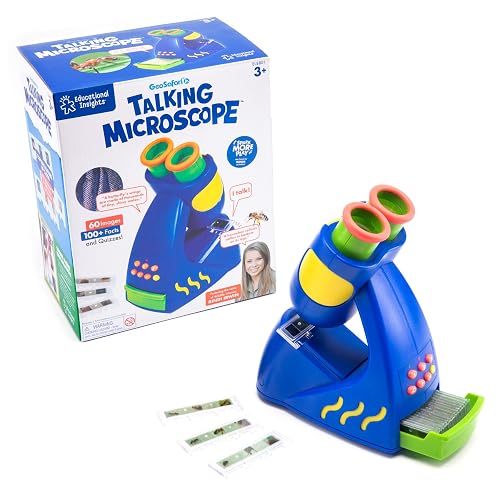 TOP CHOICEBest for preschoolersEducational Insights GeoSafari Talking MicroscopeView on Amazon
- 3
 TOP CHOICEBest for human biologySkeleton Parts Human Anatomy Squishy Body Model STEM Science KitView on Amazon
- 4
 Best for physics fundamentalsLearning Resources STEM Explorers Magnet MoversView on Amazon
- 5
 Best for experiment volumeNational Geographic Science Magic Kit with 100+ Experiments for Kids 8-12View on Amazon
Our Top Picks
| Product | Best for | Key feature |
|---|---|---|
| National Geographic Magic Chemistry Set | Ages 8–12 starting chemistry | 10 tricks built on chemical reactions |
| Educational Insights GeoSafari Talking Microscope | Ages 3–5 first microscope use | Audio prompts and image slides |
| Skeleton Parts Human Anatomy Squishy Body Model | Ages 8 and up, anatomy lessons | Articulated body model to assemble |
| Learning Resources STEM Explorers Magnet Movers | Ages 5 and up, force and magnetism | Hands-on magnetic force activities |
| National Geographic Science Magic Kit with 100+ Experiments | Ages 8–12 high-volume experimenting | 100+ experiments in one kit |
National Geographic Magic Chemistry Set with 10 Tricks for Kids Ages 8-12
Science Experiments, STEM Projects, Science Toys, Hands-On Learning, Magic Tricks, Birthday Gift National Geographic Magic Chemistry Set with 10 Tricks for Kids Ages 8-12
Best for: Overall value for a child starting to learn chemistry at home
Designed for children roughly 8 to 12, this kit uses everyday-style reagents and clear step-by-step instructions to show how color changes, gas production and state changes reflect chemical reactions. It suits a child who likes performing for others and wants to know why the tricks work.
Key specs
- Age range: 8 to 12 years (manufacturer-specified)
- Includes 10 chemistry-based magic tricks
- Illustrated instruction booklet explaining the underlying reactions
Pros
- Each trick connects to a named chemical principle, not just a visual effect
- Instructions are written for a child to follow mostly unassisted
- Good performance value for showing family and friends
Cons
- Ten tricks can be used up relatively quickly by a very keen child
- Younger children will need an adult to supervise the reagents
Bottom line: A strong first chemistry kit for a child around 8 to 12 who enjoys demonstrating what they have learned.
Educational Insights GeoSafari Talking Microscope
Kids Microscope Toy, Interactive STEM Toys and Kids Science Kits Age 3-5, Preschool Science Toy, Includes Image Slides Educational Insights GeoSafari Talking Microscope Featuring Bindi Irwin
Best for: Preschoolers taking their first look at magnified objects
This microscope is built for the youngest science learners, pairing a simple viewing setup with an audio guide that names what the child is looking at and asks questions. It is aimed at the 3 to 5 age range and works well for early observation habits.
Key specs
- Age range: 3 to 5 years (listing-specified)
- Includes image slides for viewing
- Talking audio guidance
Pros
- Audio prompts help a young child know what to look for
- Simple controls suited to small hands
- Image slides give a ready supply of subjects to examine
Cons
- Magnification is modest compared with a full student microscope
- Children tend to outgrow the audio content before the hardware wears out
Bottom line: The right first microscope for a preschooler, especially one who will be guided by an adult.
Skeleton Parts Human Anatomy Squishy Body Model STEM Science Kit
STEM Toys for 8 Year Old Boy Birthday Gift – Learning Educational Toys for Ages 8 Boys Gifts – Skeleton Parts Human Anatomy Squishy Body Model – STEM Science Kits for Boys & Girls
Best for: Learning human biology through hands-on assembly
Aimed at children around 8 and up, this kit has them build and handle a body model, which makes it useful for anatomy units where students need to see how bones and organs relate in space rather than only reading about them.
Key specs
- Age range: 8 years and up (listing-specified)
- Human anatomy model for assembly and handling
Pros
- Makes spatial relationships between body parts easier to grasp
- Suitable for both home and classroom anatomy lessons
- Appeals to children who learn best by building
Cons
- Small pieces need careful storage and are not for children under 3
- Limited to anatomy; not a broad science kit
Bottom line: A good choice for a child studying the body who learns by touching and assembling.
Learning Resources STEM Explorers Magnet Movers
Magnet Science Kit, STEM Activity Set, Physics Exploration Toy, Critical Thinking Activity, Hands-On Learning for Kids Learning Resources STEM Explorers Magnet Movers
Best for: Introducing magnetism and force in an activity-based way
This activity set is built around magnetic force experiments that ask children to predict, test and explain what they see. It fits a physics-first curriculum and works for younger elementary students, with the activity cards doing much of the guiding.
Key specs
- Designed around magnetic force and movement activities
- Activity-card format for guided experiments
Pros
- Prediction-and-test structure builds critical thinking
- Works well in small groups as well as alone
- Covers a foundational physics topic clearly
Cons
- Narrower in scope than a multi-topic science kit
- Older students may find the activities too simple
Bottom line: The best fit for a younger child or classroom group that needs a clear, hands-on introduction to magnetism.
National Geographic Science Magic Kit with 100+ Experiments for Kids 8-12
Magic Tricks, Chemistry Activities, Hands-On Science Experiments, STEM Projects, STEM Learning Toy, Birthday Gift National Geographic Science Magic Kit with 100+ Experiments for Kids 8-12
Best for: Children who want a large number of experiments in one kit
This kit stands out for experiment count, offering a broad range of activities for children around 8 to 12. It suits a child who enjoys repetition across many small investigations and wants variety rather than one deep topic.
Key specs
- Age range: 8 to 12 years (listing-specified)
- Advertised as containing 100+ experiments
Pros
- High experiment count gives long-term use
- Covers multiple science areas in one kit
- Good match for a curious child who wants variety
Cons
- Breadth can mean less depth on any single concept
- Some experiments need adult help with materials and safety
Bottom line: A strong choice for a child who wants lots of different experiments to work through over months.
Buying Guide
Age range and developmental level
Manufacturers set age ranges based on fine motor skills, reading ability and safety considerations such as small parts. A preschooler needs audio or picture-based guidance, while a child of 8 or older can follow written instructions. Match the kit to the child’s reading level, not just their birthday.
Good picks for this: GeoSafari Talking Microscope, Magic Chemistry Set
Hands-on activity versus passive learning
Look for kits where the child predicts, tests and explains, rather than only following a demonstration. Activities that produce a visible result they caused tend to build understanding better than watching a finished display.
Good picks for this: Magnet Movers, Science Magic Kit with 100+ Experiments
Number and depth of experiments
A high experiment count gives long-term use, but check whether the experiments build on each other. A smaller number of well-explained activities can teach more than a large pile of unconnected tricks.
Good picks for this: Science Magic Kit with 100+ Experiments, Magic Chemistry Set
Subject focus and curriculum fit
Decide whether you want a broad survey or a deep dive. Anatomy, magnetism, chemistry and microscopy each need different materials. If a child is studying a specific unit, choose a kit that covers that topic directly.
Good picks for this: Human Anatomy Squishy Body Model, Magnet Movers
Safety and supervision
Chemistry kits involve reagents that require adult supervision, and any kit with small parts is a choking hazard for children under 3. Read the safety notes and the age labeling before purchase. For guidance on toy safety standards, consult the US Consumer Product Safety Commission.
Good picks for this: Talking Microscope, Magic Chemistry Set
Durability and storage
Kits with many small components need an organized storage system, or pieces go missing quickly. Owners often report that plastic microscope parts and magnet pieces hold up well with normal handling, but loose components are the most common source of lost items.
Good picks for this: Human Anatomy Squishy Body Model, Magnet Movers
Replacement consumables and ongoing cost of use
Chemistry and experiment kits may need replacement materials for repeat use. Check whether the kit’s reagents are single-use and whether the manufacturer sells refills, so you can plan for ongoing use before committing.
Good picks for this: Science Magic Kit with 100+ Experiments, Magic Chemistry Set
FAQ
What age is best for educational science toys?
Most science toys are labeled for specific age bands. Preschoolers (3 to 5) do well with audio-guided or picture-based products, while children from about 8 to 12 can handle written instructions and multi-step experiments. Always check the manufacturer’s age label and your child’s reading level.
Are science kits safe for children to use alone?
Many kits are designed for independent use by older children, but chemistry activities and anything with small parts should be supervised. Read the safety instructions before the first session and keep reagents and small pieces out of reach of younger siblings.
Do educational science toys actually teach concepts?
They can, especially when the activities ask children to predict, test and explain results. Toys that only demonstrate a effect teach less than those that connect each activity to a named principle. Adult discussion after an experiment often adds the most learning value.
What is the difference between a microscope toy and a real microscope?
A toy microscope typically offers lower magnification and simpler optics, and it is designed for durability and ease of use by young children. A student microscope offers higher magnification and more adjustable controls, and it suits older students doing detailed observation.
How do I keep a science kit interesting over time?
Rotate experiments rather than doing them all at once, and let the child choose what to try next. Pairing an activity with a question, such as “what do you think will happen if we change this?”, keeps the learning active.
Can science toys support homeschool or classroom lessons?
Yes. Kits that map to a specific topic, such as magnetism or anatomy, fit well into a unit plan. Activity-card formats also work for small group rotations. Check that the kit’s materials will last for the number of students you plan to serve.
Conclusion
For most families, the National Geographic Magic Chemistry Set is the strongest all-round choice for children around 8 to 12 who want to learn real chemistry through demonstrations. Younger children will get the most from the GeoSafari Talking Microscope, while the anatomy model suits a unit on the body and the Magnet Movers set suits a focused magnetism lesson. Children who want variety above all should consider the 100+ experiment kit. Match the product to the child’s age, reading level and the topic they are actually studying.
Sources
- Toy safety standards, age labeling guidance and recalls for children's products (cpsc.gov)
- Science education resources, standards alignment and classroom activity guidance
- Age-appropriate STEM activities and educational materials for young learners (nasa.gov)