

As an Amazon Associate I earn from qualifying purchases.
Updated November 2026
Shopping for a compound light microscope for sale online can be confusing, because listings mix magnification claims, eyepiece types and accessories in ways that are hard to compare. This guide narrows the field to seven models that cover the main needs: first-time student use, homeschool labs, adult hobbyists and more demanding lab work. Selection was based on published specifications, the brand’s reputation for optics, and common patterns in owner feedback.
Our top picks at a glance
- 1
 TOP CHOICEBest overallPalliPartners Compound Microscope for Adults & Students, WhiteView on Amazon
- 2
 TOP CHOICEBest for homeschool labsCompound Microscope, WF10x and WF25x Eyepieces, Bright WhiteView on Amazon
- 3
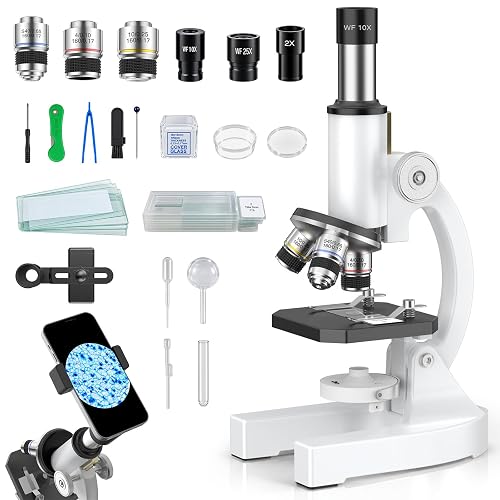 TOP CHOICEBest budget pickHKMK Microscope for Adults & KidsView on Amazon
- 4
 Best for classroom demonstrationsBinocular Microscope for Adults with Experiment Kit and Phone AdapterView on Amazon
- 5
 Best for digital imagingAmScope M620C-SP14-CLS-50P100S 2500X LED Digital Monocular CompoundView on Amazon
- 6
 Best for portable useSWIFT Compound Monocular Microscope SW200DLView on Amazon
- 7
 Best for advanced lab workTrinocular Microscope 40X–5000X Laboratory Grade with HD USB CameraView on Amazon
Our Top Picks
Quick Comparison
| Product | Best for | Key feature |
|---|---|---|
| PalliPartners Compound Microscope for Adults & Students | All-round home and school use | 100X–2000X range with slide set and phone adapter |
| Compound Microscope with WF10x and WF25x Eyepieces | Homeschool and lab study | Wide-field eyepieces for a larger viewing area |
| HKMK Microscope for Adults & Kids | Budget-conscious families | 40X–2000X range with experiment kit |
| Binocular Microscope for Adults | Classroom demonstrations | Binocular viewing with up/down LED lighting |
| AmScope M620C-SP14-CLS-50P100S | Digital imaging and sharing images | 40X–2500X range with built-in LED illumination |
| SWIFT Compound Monocular Microscope SW200DL | Portable and beginner use | 40X–1000X with dual light and cordless capability |
| Trinocular Microscope 40X–5000X Laboratory Grade | Advanced lab and camera work | Trinocular head with dual mechanical stage and USB camera |
PalliPartners Compound Microscope for Adults & Students, White
100X-2000X High-Power, Biological Microscope, School Lab & Home Education, with Slides Set & Phone Adapter PalliPartners Compound Microscope for Adults & Students, White
Best for: All-round home and school use
This model suits a student who needs one microscope for classwork, science projects and general exploration at home. Its listing emphasizes a broad magnification range, which is useful for moving from low-power views of pond water to higher-power views of cells.
Key specs
- Magnification range: 100X–2000X (per listing)
- Includes a slide set and phone adapter (per listing)
- Intended for schools, labs and home education (per listing)
Pros
- Wide magnification range covers most student coursework
- Slide set means you can start observing right away
- Phone adapter allows simple photos of what you see
Cons
- Lower-end magnification figures are usually more useful than the top number
- Accessory quality varies by owner experience, so inspect the slides on arrival
Bottom line: A strong first choice for a student or family that wants one flexible microscope with the basics included.
Compound Microscope, WF10x and WF25x Eyepieces, Bright White
Compound MicroscopeWF10x and WF25x Eyepieces, Slides for Students, Home School Lab Microscope for Adults Suitable for Laboratory School (Bright White)
Best for: Homeschool and lab study
Families running structured science lessons will appreciate the eyepiece pairing. Wide-field eyepieces show more of the specimen at once, which makes it easier for a beginner to find and track what they are looking at.
Key specs
- Eyepieces: WF10x and WF25x (per listing)
- Slides included for student use (per listing)
- Designed for home school and laboratory settings (per listing)
Pros
- Wide-field eyepieces ease specimen tracking
- Bright white illumination suits detailed observation
- Suitable for both teen and adult learners
Cons
- Magnification depends on the objective lens combination, so confirm the full range before buying
- Less suited to digital imaging without an added camera or adapter
Bottom line: Good for a homeschool family that values a comfortable view and a clear lesson structure.
HKMK Microscope for Adults & Kids
HKMK Microscope for Adults & Kids,40X-2000X Compound Microscope,with a Experiment Kit & Phone Adapter,for Students Home Schooling and Lab
Best for: Budget-conscious families
This is a practical option for households that want to introduce microscopy to children without committing to a premium instrument. It is aimed at both kids and adults, so it can serve as a shared family tool.
Key specs
- Magnification range: 40X–2000X (per listing)
- Includes an experiment kit and phone adapter (per listing)
- Intended for students, home schooling and lab use (per listing)
Pros
- Accessible entry point for families and younger users
- Experiment kit provides immediate hands-on activities
- Phone adapter supports simple documentation
Cons
- Optical quality at the highest magnifications is generally lower than in lab-grade models
- Mechanical build may feel lighter than premium competitors, according to some owner comments
Bottom line: A sensible starting point for a family that wants to explore, with room to upgrade later.
Binocular Microscope for Adults with Experiment Kit and Phone Adapter
Binocular Microscope for Adults,with WF10x/25x Eyepieces,40X-2000X Magnification,Up/Down LED,with a Experiment Kit & Phone Adapter.Suitable for Labs,Schools,and Home Education
Best for: Classroom demonstrations
Binocular viewing reduces eye strain during longer sessions, which matters when a teacher or parent is guiding several observers. The up/down LED lighting also helps when showing the same slide to a group.
Key specs
- Binocular head with WF10x and WF25x eyepieces (per listing)
- Magnification range: 40X–2000X (per listing)
- Up/down LED lighting and experiment kit (per listing)
Pros
- Binocular viewing is more comfortable for extended use
- Up/down LED lighting helps with different specimen types
- Experiment kit supports structured lessons
Cons
- Heavier than monocular models, so it needs a stable bench
- Binocular designs cost more in optics and can be more sensitive to alignment
Bottom line: Best for teachers and tutors who need a comfortable view for more than one person at a time.
AmScope M620C-SP14-CLS-50P100S 2500X LED Digital Monocular Compound
40X-2500X Magnification Range Compound Biological Microscope Built-In LED Illumination AmScope M620C-SP14-CLS-50P100S 2500X LED Digital Monocular Compound
Best for: Digital imaging and sharing images
Users who want to save images, record progress or share findings with a class or online group will find the digital focus here useful. The listing names a high magnification ceiling and built-in LED illumination.
Key specs
- Magnification range: 40X–2500X (per listing)
- Built-in LED illumination (per listing)
- Digital monocular compound design (per listing)
Pros
- Built-in LED removes the need for a separate light source
- Digital capability supports documentation and sharing
- Wide magnification range for varied specimens
Cons
- Image quality at the top magnification depends heavily on specimen prep and focus technique
- Software setup may take some patience, based on common owner comments
Bottom line: A good pick for someone who wants to combine microscopy with photography or classroom projection.
SWIFT Compound Monocular Microscope SW200DL
SWIFT Compound Monocular Microscope SW200DL with 40X-1000X Magnification, Dual Light, Precision Fine Focus, Wide-Field 25X Eyepiece and Cordless Capability for Student Beginner
Best for: Portable and beginner use
A monocular head with cordless capability makes this model easier to move between a desk, a kitchen table and a field outing. The dual light option gives flexibility with transmitted and reflected-style setups.
Key specs
- Magnification range: 40X–1000X (per listing)
- Dual light and precision fine focus (per listing)
- Wide-field 25X eyepiece and cordless capability (per listing)
Pros
- Cordless design suits portable use
- Fine focus helps beginners sharpen images
- Wide-field eyepiece makes it easier to locate specimens
Cons
- Maximum magnification is lower than some competitors
- Battery life can be a limiting factor on long sessions
Bottom line: Ideal for a beginner who wants a light, mobile instrument for everyday observation.
Trinocular Microscope 40X–5000X Laboratory Grade with HD USB Camera
Trinocular Microscope 40X-5000X Magnification Laboratory Grade with Dual Mechanical Stage and HD USB Camera Microscopes for Adults(Adult Trinocular Microscope with Electronic Eyepiece)
Best for: Advanced lab and camera work
This is the most advanced model in the set. The trinocular head allows a camera to be mounted while the user keeps viewing through the eyepieces, and the dual mechanical stage gives more precise specimen control.
Key specs
- Magnification range: 40X–5000X (per listing)
- Trinocular head with HD USB camera (per listing)
- Dual mechanical stage (per listing)
Pros
- Trinocular head lets you observe and capture images at once
- Dual mechanical stage supports precise slide movement
- High magnification ceiling for advanced specimens
Cons
- Higher magnification figures are rarely usable without excellent specimen prep and proper lighting
- Setup and calibration take more time than entry-level models
Bottom line: Best for serious hobbyists or lab-minded users who need imaging and precise stage control.
Buying Guide
Magnification Range and Real Usable Power
Manufacturers often advertise total magnification, which is the eyepiece power multiplied by the objective power. For most school and home work, 40X to 400X covers the majority of observations, including plant cells, protists and insect parts. The top numbers, such as 1000X or higher, are only useful with thin, well-prepared specimens and good lighting. Ask yourself what you actually plan to look at before you pay attention to the highest figure.
Good picks for this: PalliPartners Compound Microscope for Adults & Students, HKMK Microscope for Adults & Kids
Eyepieces and Field of View
Eyepiece designations such as WF10x and WF25x indicate the eyepiece magnification and, in wide-field designs, a larger field of view. Wide-field eyepieces make it easier to find and follow a specimen, which matters for beginners who are still learning to navigate a slide. Check whether the listing states the eyepiece type clearly.
Good picks for this: Compound Microscope with WF10x and WF25x Eyepieces, Binocular Microscope for Adults
Monocular vs. Binocular vs. Trinocular Heads
Monocular heads have one eyepiece and are light and inexpensive to build. Binocular heads use two eyepieces, which reduces eye fatigue during longer sessions. Trinocular heads add a third port for a camera, so you can observe and photograph at the same time. Choose based on how long you will look through the instrument and whether you need imaging.
Good picks for this: Binocular Microscope for Adults, Trinocular Microscope 40X–5000X Laboratory Grade
Illumination Type
Built-in LED lighting is the most common choice today because it is bright, cool-running and needs no external lamp. Look for adjustable brightness, and for models that offer both top and bottom light, since transparent and opaque specimens need different lighting. Dual-light designs add flexibility when you move between slides and solid objects.
Good picks for this: AmScope M620C-SP14-CLS-50P100S 2500X LED Digital Monocular Compound, SWIFT Compound Monocular Microscope SW200DL
Size, Weight and Portability
Think about where the microscope will live. A heavier base with a mechanical stage is stable on a lab bench but harder to move. Cordless and compact designs suit kitchen tables, car trips and classroom carts. Check the listing for dimensions and whether it includes a dust cover or case to protect the optics between uses.
Good picks for this: SWIFT Compound Monocular Microscope SW200DL, PalliPartners Compound Microscope for Adults & Students
Imaging and Digital Connectivity
If you want to save images or project specimens, confirm how the camera connects. Some models use a USB camera on a trinocular port, while others rely on a phone adapter that holds a smartphone over the eyepiece. Phone adapters are simple but less precise, so check whether the listing names compatible phone sizes. For more detail on digital setups, see our guide on Compound Microscope with Camera: A Step-by-Step Setup and Buying Guide.
Good picks for this: Trinocular Microscope 40X–5000X Laboratory Grade, HKMK Microscope for Adults & Kids
Durability, Care and Accessories
Optics last a long time when kept clean and covered. Use lens paper and a blower rather than fabric on the lenses, store the instrument with the dust cover on, and keep slides in a closed box. Included slide sets and experiment kits are useful starting points, but check the quality of the slides when they arrive. For learning the parts before you start, Compound Microscope Parts and Functions: A Complete Guide for Students is a helpful reference.
Good picks for this: PalliPartners Compound Microscope for Adults & Students, Compound Microscope with WF10x and WF25x Eyepieces
FAQ
What magnification do I really need for school biology?
Most middle and high school biology work uses magnifications between 40X and 400X. This range is enough to see cell walls, nuclei in onion cells and the structure of many small organisms. Higher powers are helpful for bacteria or fine tissue, but they demand careful specimen preparation.
Is a compound light microscope the same as a stereo microscope?
No. A compound light microscope passes light through a thin specimen and is used for magnified views of slides. A stereo microscope gives a lower-power, three-dimensional view of solid objects and is better for dissection or examining coins and insects. Some buyers need both, so check which one your project calls for.
Do I need a camera to use a compound microscope?
No. The microscope works fully with just the eyepieces. A camera or phone adapter is useful if you want to save images, share them with a class or measure features, but it is an optional accessory for most users.
How do I keep the lenses clean?
Use a blower to remove dust, then wipe with lens paper and a small amount of approved optical cleaning solution if needed. Avoid household cleaners and paper towels, which can scratch coatings. Always cover the instrument when it is not in use.
Is a budget microscope good enough for children?
For ages around 8 and up, a basic student model with a clear focus system and a useful magnification range is usually enough. Supervise young children when handling slides and keep glass slides and any chemical stains away from them. Adult supervision is recommended for all glass and chemical handling.
Can I use a compound microscope to examine liquids?
Yes, but you need to prepare the sample. Place a drop on a clean slide, cover it with a coverslip, and avoid trapping air bubbles. Liquid samples can be fragile and messy, so work over a tray and dispose of materials according to your school or household guidance.
Conclusion
There is no single right answer for a compound light microscope for sale, because the best fit depends on the user. For an all-round student instrument, the PalliPartners model is a sensible starting point. Homeschool families may prefer the wide-field eyepiece setup, while budget-minded households can consider the HKMK model. Teachers who present to groups will benefit from the binocular design. Digital imaging users should look at the AmScope LED monocular, and portable beginners may favor the SWIFT cordless model. For advanced lab and camera work, the trinocular microscope is the most capable option in this set. Match the magnification range, head type and lighting to what you actually plan to observe, and you will get more value from the instrument.
Sources
- Background on microscopy techniques, specimen preparation and laboratory safety resources (nih.gov)
- Guidance on laboratory safety and handling of biological materials (cdc.gov)
- Science education resources and research on hands-on learning with instruments (nsf.gov)
Before you buy: helpful guides